Financial Access & Everyday Money Report 2026
Public evidence on financial pressure and practical decisions in the United States
English edition · Published October 29, 2026 · Publisher: MoneyFAQ · Educational research review
At a glance
of adults could not cover a $400 emergency by any means [1]
of adults with family income below $25,000 did not pay all bills last month [2]
of U.S. households were underbanked in 2023; 4.2% unbanked [3]
credit applicants in 2025 were denied or received less than requested [5]
of banked adults paid an overdraft fee in the preceding 12 months [4]
of renters were behind on rent at some point in 2025 [11]
Each figure uses its own base population; they are not additive.
Executive summary
Financial access involves more than opening an account or qualifying for credit. The research reviewed here points to three recurring needs: room in the budget for disruptions, affordable ways to manage payments, and information people can understand when a decision becomes urgent.
This report connects national evidence with practical checklists for people managing tight budgets, establishing or rebuilding credit, or navigating financial services in a preferred language. Its contribution is an educational synthesis and usable decision tools. It does not present a new consumer survey or demonstrate that financial education improves outcomes.
Five findings that matter
- 1
Emergency preparedness varies. In 2025, 63% of adults would cover a $400 emergency with cash or its equivalent; 12% could not cover it by any means. [1]
- 2
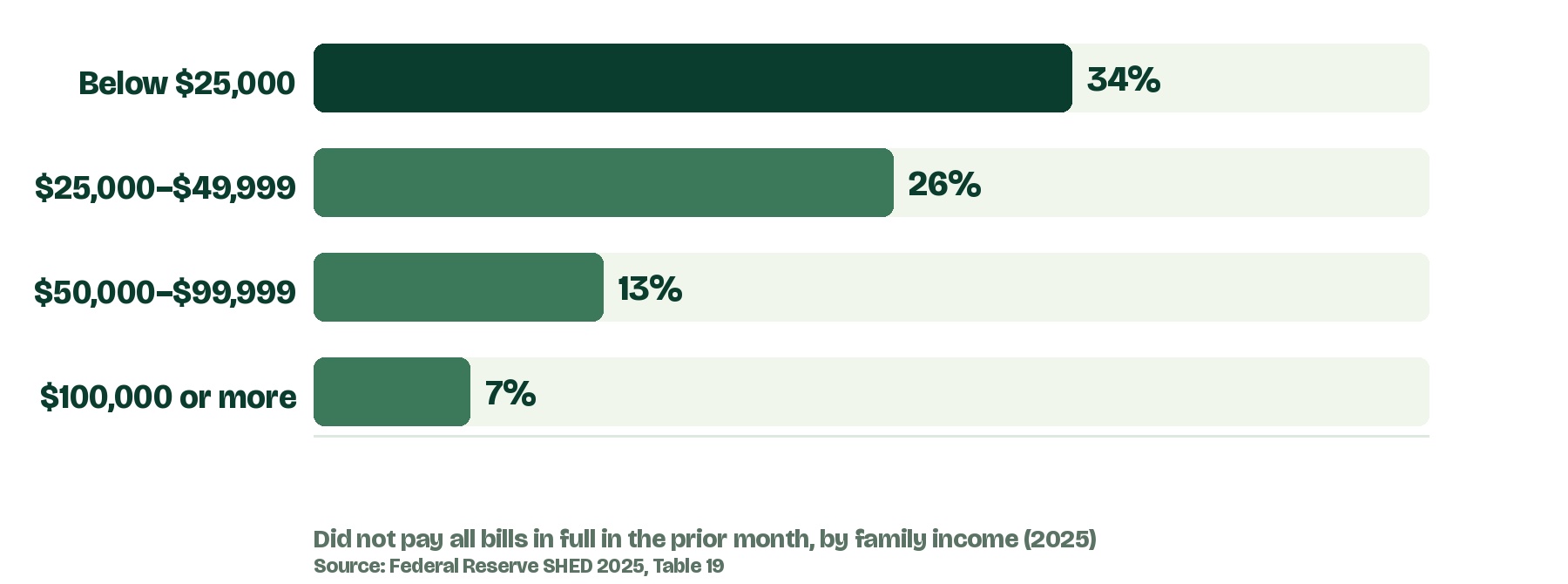
Missed bills are concentrated among lower-income adults. 34% of adults with family income below $25,000 did not pay all bills in full in the prior month, compared with 7% at $100,000 or more. [2]
- 3
An account does not eliminate fees. In 2025, 12% of banked adults reported an overdraft fee during the preceding 12 months. [4]
- 4
Approval and affordability are separate questions. One-third of people who applied for credit in 2025 were denied or received less than requested. [5]
- 5
Language access matters beyond translation. Earlier research documents barriers in documents, servicing and problem resolution; it does not establish a national 2026 English–Spanish outcome gap. [7–9]
Emergency savings and bill pressure
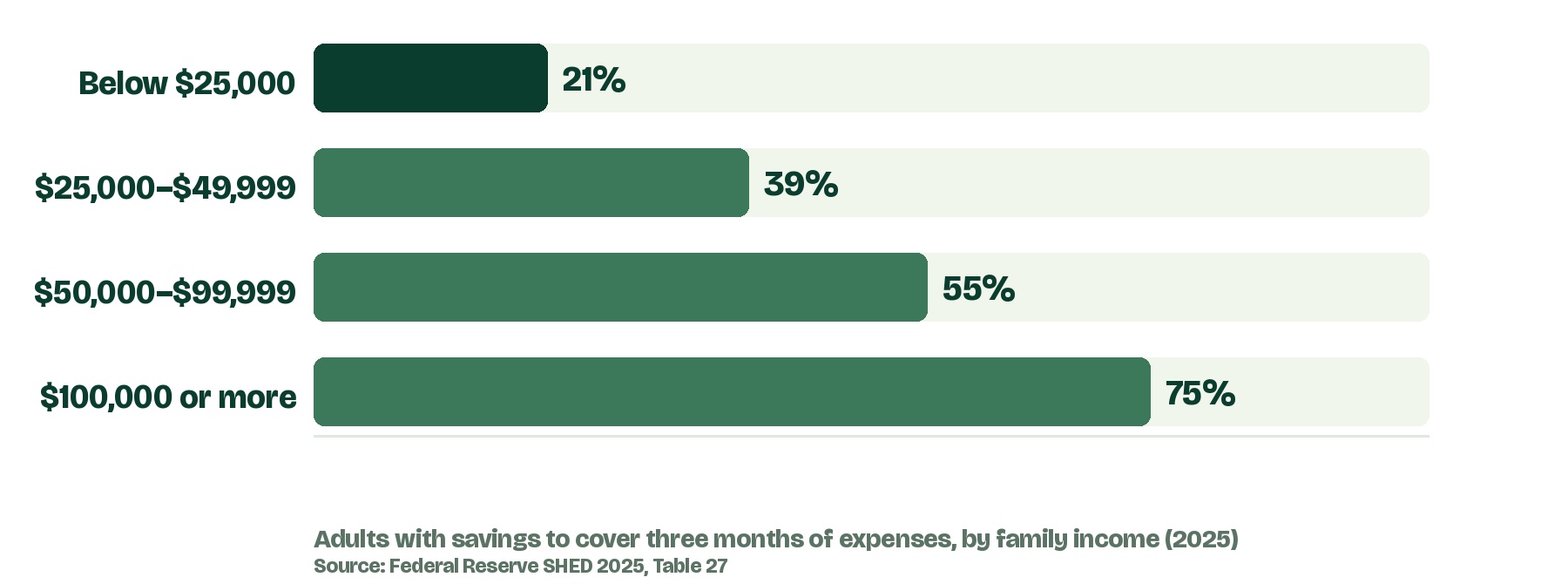
In the Federal Reserve's 2025 survey, 55% of adults had emergency savings for three months of expenses. The difference between the highest and lowest family-income bands was 54 percentage points: 75% minus 21%. This is MoneyFAQ arithmetic using published estimates, not a new survey finding or a causal effect of income. [1]
The $400 emergency question measures something different. “Cash or its equivalent” includes a card paid off at the next statement. The 37% who would use other methods or could not pay should not all be described as lacking $400. [1]
Compare the next expense
A worked cash shortfall example
Illustration only, not survey data or an actual offer. A household has $300 available, an essential $400 repair due now, and $200 of other necessities due before the next payday. Using all available cash for the repair would leave those necessities unfunded. The combined shortfall is $300: $400 + $200 − $300.
| Hypothetical arrangement | Cash flow and cost | Question before agreeing |
|---|---|---|
| Repair provider accepts $100 now and $300 after payday, without a fee | $200 remains for necessities; $300 is due after payday. | Will the next paycheck cover $300 plus the next round of essentials? |
| Use $100 cash and finance $300; three monthly payments of $110 | $200 remains now; total repayment is $330. The stated financing cost is $30. | Are there other fees, automatic debits or consequences if a payment fails? |
| Use $100 cash and receive $300 from family | $200 remains now. Future obligations depend on whether the money is a gift or a loan. | If repayment is expected, what amount and date can both people accept? |
These options may not be available. The financing example excludes additional charges by assumption and is not an APR comparison. A cheaper arrangement can still fail if its payment falls before income arrives. Compare the complete written terms, the payment dates and the amount remaining for necessities.
Banking access and overdraft fees
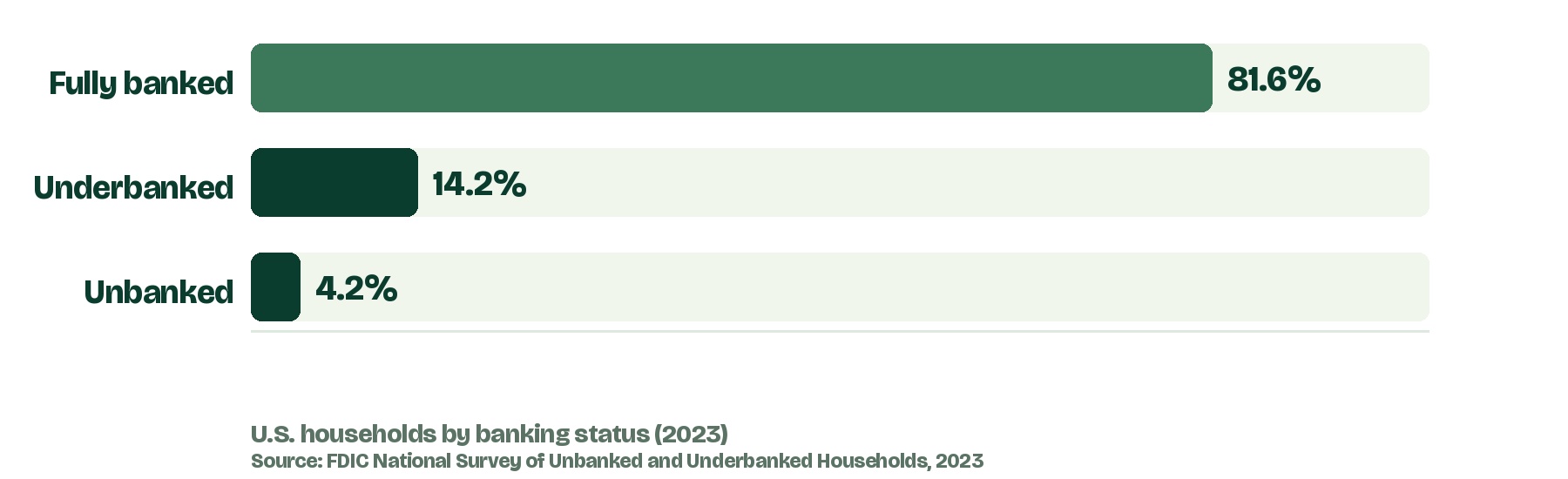
The FDIC estimated that 4.2% of U.S. households were unbanked in 2023 and 14.2% were underbanked. Underbanked households had an account but used specified nonbank financial services. Because these include some remittance and transaction services, the category is not itself evidence of financial distress. [3]
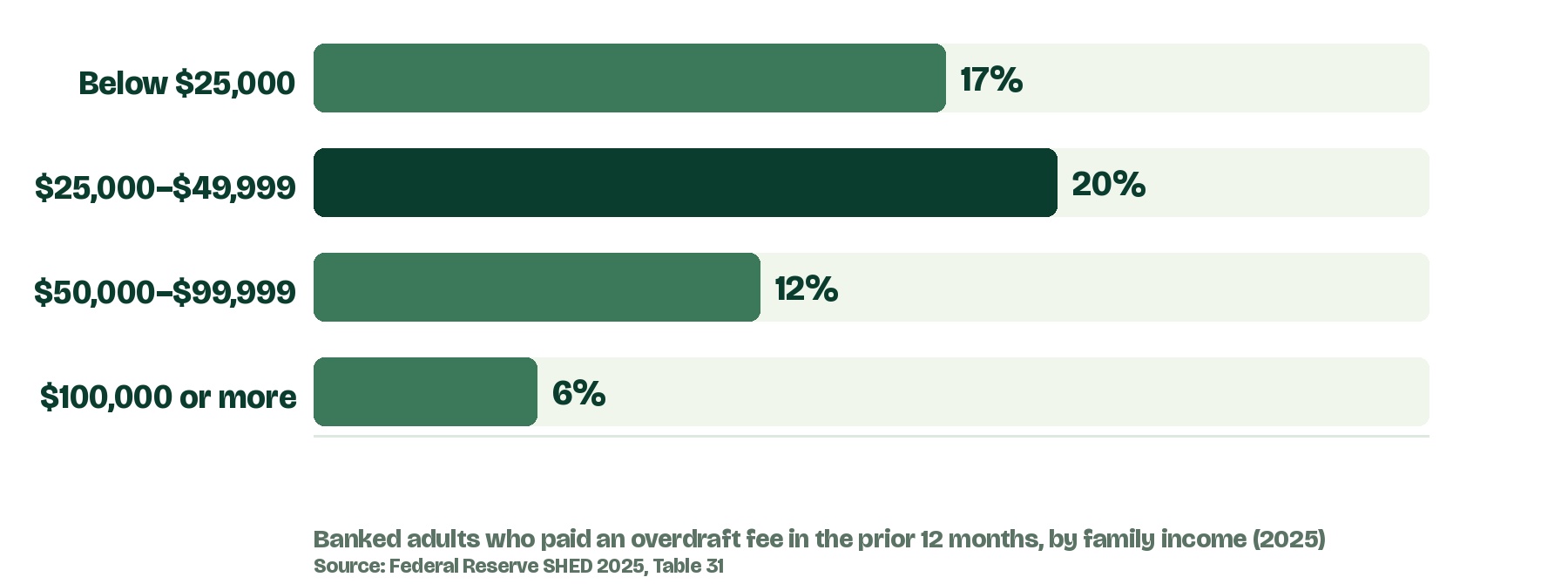
Account use also creates timing and cost questions. In the 2025 survey, overdraft-fee incidence ranged from 6% among banked adults in the highest income band to 20% in the $25,000–$49,999 band. These percentages record whether a fee occurred, not its amount or frequency. [4]
Check the account and credit terms
An account comparison checklist
Use the same questions for each account. Record the answer from the current fee schedule or provider, plus the date checked. An unanswered question is a reason to request clarification, not proof that a charge is zero.
| Compare | Record for each account |
|---|---|
| Recurring costs | Monthly fee; conditions for a waiver; whether you can reliably meet them. |
| Access to money | Deposit availability; cash-deposit and ATM charges; transfer timing and limits. |
| Low balance or failed payment | Whether the payment is declined, returned or covered; each possible fee and whether another party may charge separately. |
| Controls and support | Balance alerts; available payment settings; preferred-language support for account problems. |
| Opening and verification | Documents the provider accepts; any additional verification; ask directly rather than assuming eligibility. |
Credit access in context: in 2025, 33% of adults applied for credit. Sixteen percent used Buy Now, Pay Later; among those users, 11% said a payment triggered an overdraft or insufficient-funds fee. That 11% is a share of BNPL users, not all adults. [5]
At Q2 2026, credit-card balances totaled $1.263 trillion and auto-loan balances $1.713 trillion. The annualized share of card balances newly entering serious delinquency was 6.97%, versus 6.93% a year earlier. This balance-based measure is not the percentage of people delinquent. [6]
After a denial, read the stated reason
| Illustrative reason | A useful next question |
|---|---|
| Limited credit history | What information was missing or insufficient? What records were used? |
| Income or obligations | Was the information accurate, and would the proposed payment fit after essentials? |
| Late payments or report information | Which entries affected the decision? If an entry seems wrong, what is the reporting company's correction process? |
These are illustrative prompts, not interpretations of a specific notice or promises of approval. A missing score differs from a low score. The CFPB's 2025 credit-invisibility correction revised population estimates; it did not establish a corresponding improvement in individual credit access. [10]
Language access and newcomer needs
An immigrant experience is not a credit category. Someone new to the United States may be financially secure and fluent in English. A person who prefers Spanish may be U.S.-born. Income, credit history, preferred reading language and immigration background should be considered separately.
The CFPB's 2017 spotlight described language barriers in documents, account management and problem resolution — historical evidence about types of obstacles, not their prevalence in 2026. [7] NCLC's 2024 advocacy research adds qualitative context on consumer reporting, tenant screening, debt collection and loan servicing; it is not a representative estimate. [8] CFPB usability research (fieldwork 2022, published 2023) favored concise, mobile-friendly explanations and English reference terms alongside translations; its focus groups did not include Spanish, so applying it to Spanish materials is a hypothesis to test. [9]
Terms worth recognizing on a document
| English term | Plain-language question |
|---|---|
| Annual percentage rate (APR) | What annualized credit-cost figure is disclosed, and what additional costs should I check? |
| Payment due date | When must the payment arrive, and how long does this payment method take? |
| Insufficient funds (NSF) | What happens if there is not enough available money for this transaction? |
| Adverse action notice | What decision was made, what reasons or instructions are given, and what can I check next? |
Questions to ask before completing a transaction
- Can I read the important fees, payment dates and limitations in my preferred language?
- Does language support continue after sign-up, including when a payment fails or a document is disputed?
- Which English terms will appear on the actual agreement or account screen? Can someone explain how they match the translated information?
- What documents does this provider accept, and who can answer questions about my particular circumstances?
- For a money transfer, what will I pay in total, what amount will the recipient receive, and when will it arrive?
This English edition does not claim to provide bilingual services or determine anyone's legal status. For legal or immigration questions, use qualified help that can assess the individual facts.
Essential bills and assistance
The Federal Reserve reported that 23% of renters were behind on rent at some point in 2025, compared with 21% in 2024. These are renter figures, not percentages of all households. [11]
USDA estimated SNAP participation at 88% of eligible individuals in fiscal year 2022. The remainder cannot be labeled an awareness gap: participation data alone do not reveal why people did not take part. [12]
A worksheet for finding and verifying help — complete one copy per resource
| Field | What to write down |
|---|---|
| Need and deadline | Bill or expense, amount, due date. |
| Program and provider | Program name; administering organization. |
| Official source | Official page or phone number; date checked. |
| Type of help | Grant, discount, payment arrangement or repayable loan. |
| Eligibility questions | Location, income, household and other requirements to verify. |
| Application steps | Required documents, application method and any deadline. |
| Cost and obligations | Any fee, repayment obligation or later condition. |
| Timing and next contact | Expected response time; what happens before the bill is due; follow-up date. |
| Outcome | Submitted, more information requested, approved or declined. |
Methodology and limits
This is a targeted public-source review prepared for MoneyFAQ, with a source cutoff of October 29, 2026. It is not a systematic review, original survey, forecast or product evaluation. Government sources supply the numerical estimates; identified advocacy research supplies qualitative context.
The report uses published figures, not reweighted microdata. Two transparent calculations are included: the 54-percentage-point emergency-savings difference and the 81.6% fully banked share. The cash-shortfall example is fictional arithmetic, and the worksheets are editorial tools, not validated interventions.
Observation periods differ (SHED 2025; FDIC 2023, 50 states and D.C.; New York Fed Q2 2026; USDA FY2022; language-access publications 2017–2024). These measures cannot be added or treated as a single time series. No national English–Spanish outcome gap, immigrant market size, Puerto Rico-specific finding, combined fee burden or universal “super-subprime” threshold is estimated. The report does not identify the financial condition of MoneyFAQ users.
Publisher: MoneyFAQ. No independent external review, original customer research or source-organization endorsement is claimed. This report contains no product rankings or affiliate links. It is general information, not individualized financial, legal, tax or eligibility advice.
Suggested citation: MoneyFAQ. MoneyFAQ Financial Access and Everyday Money Report 2026. English edition, October 29, 2026. Cite the originating publication as well when reusing an individual statistic.
Sources
All sources checked October 29, 2026. Links go to the original publisher.
- [1]Federal Reserve — Economic Well-Being of U.S. Households in 2025: Savings and Investments (Tables 25, 27)
- [2]Federal Reserve — Economic Hardships (Tables 19, 20)
- [3]FDIC — 2023 National Survey of Unbanked and Underbanked Households (2024 release)
- [4]Federal Reserve — Banking (Table 31)
- [5]Federal Reserve — Credit (applications, alternative loans, BNPL)
- [6]Federal Reserve Bank of New York — Household Debt Balances Decreased Slightly (Aug 11, 2026; Q2 2026)
- [7]CFPB — Spotlight on Serving Limited English Proficient Consumers (Nov 2017)
- [8]NCLC — Cracking the Code (Nicole Cabañez, Sep 2024)
- [9]CFPB — Strengthening Information Accessibility (Feb 2023, archived)
- [10]CFPB — Technical Correction and Update to Credit Invisibles Estimate (Jun 2025)
- [11]Federal Reserve — Housing (rent payment difficulty)
- [12]USDA — Trends in SNAP Participation Rates FY 2020 and 2022
- [13]Federal Reserve — Survey of Household Economics and Decisionmaking (SHED)
Educational content only — not financial, legal, tax or eligibility advice. © 2026 MoneyFAQ.